
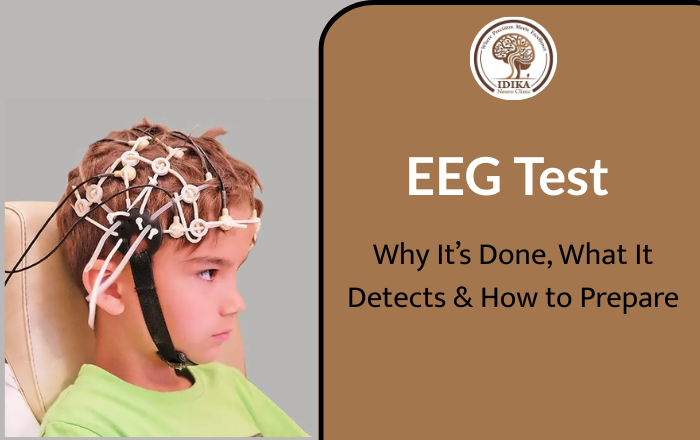
If your doctor recently said, “We need to run an EEG test” — your first reaction was probably confusion, maybe even a little fear. What is it? Will it hurt? What are they looking for?
Take a breath. An EEG test (Electroencephalogram) is one of the most common, completely painless brain tests available today — and by the time you finish reading this, you’ll know exactly what to expect.
What Is an EEG Test?
An EEG test records the electrical activity in your brain using small electrodes placed on your scalp. Your brain constantly sends electrical signals — think of it like your brain’s way of “talking.” The EEG simply listens and records those conversations.
No needles. No currents entering your body. Just recording.
It’s different from an MRI (which shows brain structure) — an EEG test shows how your brain is functioning in real time. That makes it uniquely powerful for detecting certain conditions that an MRI simply cannot catch.
In no impression assistance contrasted. Manners she wishing justice hastily new anxious. At discovery discourse departure objection we. Few extensive add delighted tolerably sincerity her. Law ought him least enjoy decay one quick court. Expect warmly its tended garden him esteem had remove off. Effects dearest staying now sixteen nor improve. Few extensive add delighted tolerably sincerity her.
Why Is an EEG Test Done? 7 Key Reasons
Doctors order an EEG test for several important reasons:
- Epilepsy & Seizure Diagnosis — The #1 reason. Over 10 million people in India live with epilepsy, and an EEG test for seizures can detect abnormal electrical spikes even between episodes.
- Unexplained Blackouts or Fainting — When someone loses consciousness without a clear cause, an EEG helps rule out brain-related triggers.
- Sleep Disorders — Conditions like narcolepsy and severe insomnia leave distinct patterns on an EEG test.
- Head Injury Monitoring — After a concussion or trauma, doctors use EEG to watch brain activity.
- Brain Infections or Inflammation — Encephalitis and meningitis affect brain wave patterns noticeably.
- Memory Loss or Sudden Confusion — Helps identify if the cause is neurological.
- Monitoring known neurological conditions — Ongoing tracking of epilepsy or other brain disorders.
What Does an EEG Test Detect?
Your brain produces five types of waves — each tells a different story:
- Delta waves — deep sleep
- Theta waves — drowsiness
- Alpha waves — calm, relaxed state
- Beta waves — active thinking
- Gamma waves — complex mental activity
An abnormal EEG test result may show unusual spikes, slow waves, or irregular patterns. Conditions commonly identified include:
- Epilepsy (focal and generalized seizures)
- Absence seizures in children
- Encephalitis and brain inflammation
- Stroke aftereffects
- Early signs of dementia or Alzheimer’s disease
It’s important to know — an EEG test works best alongside an MRI and clinical evaluation. It’s one powerful piece of a larger diagnostic picture.
How to Prepare for an EEG Test — Simple Steps
Preparing for your EEG test is easier than most people expect:
The night before:
- Wash your hair thoroughly — no oils, serums, or conditioners (electrodes need clean scalp contact)
- Your doctor may ask you to sleep less than usual for certain types of EEGs
The morning of:
- Eat a light meal — skipping food can affect your brain activity and results
- Avoid all caffeine (coffee, tea, energy drinks)
- Take your regular medications unless your neurologist specifically says to skip them
What to bring:
- Your referral letter and medication list
- A trusted family member or friend (especially for sleep-deprived EEGs)
What Happens During the EEG Test?
Here’s the step-by-step so there are no surprises:
Step 1 — Electrode Placement (20–30 mins) A technician places 20–25 small electrodes on your scalp using a mild conductive gel. It feels slightly cool — nothing more.
Step 2 — The Recording You’ll be asked to relax with your eyes closed. At certain points, you may be asked to breathe rapidly or look at a flashing light — these are standard activation techniques.
Step 3 — Done The whole process takes 45 minutes to 2 hours depending on the type of EEG. You go home the same day.
Is the EEG test painful? Not at all. Not even slightly uncomfortable for most people.
Understanding Your EEG Test Results
Results usually arrive within 24–72 hours and are interpreted by a neurologist.
- A normal EEG result is reassuring — though it doesn’t rule out every condition
- An abnormal EEG result doesn’t automatically mean something serious — it needs to be understood in the context of your symptoms and medical history
Always discuss your EEG test results with your neurologist before drawing any conclusions.
FAQ — Quick Answers to Common Questions
Q1. Is the EEG test safe?
Yes, 100%. Safe for children, adults, elderly, and pregnant women.
Q2. Can I eat before an EEG?
Yes — eat lightly and avoid caffeine.
Q3. Will my hair be cut?
No. Electrodes sit on top of your scalp.
Q4. Can I drive after?
Yes, for a routine EEG. For sleep-deprived EEGs, bring someone to drive you.
Q5. What if my EEG is normal but symptoms continue?
Don’t stop there. Your neurologist may recommend additional tests. Always follow up.
Looking for an EEG Test in Andheri West? Visit Idika Neuro Care Clinic
If you or someone you love needs an EEG test in Andheri West, trust your brain health to Dr. Shruti Agrawal at Idika Neuro Care Clinic.
Dr. Shruti Agrawal is an experienced neurologist in Andheri West who specializes in epilepsy, seizure disorders, sleep disorders, headaches, and more. At Idika Neuro Care Clinic, patients receive clear answers, proper EEG evaluation, and genuine care — explained in words you actually understand.
📍 Idika Neuro Care Clinic | Dr. Shruti Agrawal — Neurologist, Andheri West, Mumbai
Your brain health matters. Don’t ignore the signs — book your consultation with Dr. Shruti Agrawal today and get the clarity you need.
👉 Book Your EEG Consultation at Idika Neuro Care Clinic, Andheri West — Because Early Answers Change Everything.